What is a faceless YouTube channel? It’s a channel where the owner never appears on camera — narration, text, stock footage, screen recordings or an AI avatar carry the video — and yes, it can be monetized under standard YouTube Partner Program rules.
What is a faceless YouTube channel?
Definition: A faceless YouTube channel is a channel whose owner never appears on camera. Narration, on-screen text, stock footage, screen recordings, animation or an AI avatar carry every video instead.
The term describes a production decision, not a subject. A cooking channel that shows only hands kneading dough, a personal finance channel built on charts and a steady voiceover, and a history channel assembled from public-domain archive footage all sit inside the same definition.
Viewers still meet a personality. They hear a voice, notice which jokes land, and learn whose opinion they are getting on a new console or on index funds. Faceless does not mean anonymous — plenty of faceless creators put a real name and a contact email in the About tab.
Three practical reasons push creators toward it. Privacy matters for teachers, nurses and anyone whose employer monitors public posts. Speed matters for a solo editor who can record four voiceovers in a morning but would need a full day of lighting, wardrobe and retakes to film the same scripts.
There is one more reason creators rarely admit: camera presence is a separate skill. Writing and narrating well is learnable in weeks. Being watchable on camera takes longer, and a faceless format lets you ship while you build the rest.
What counts as "faceless" — and what doesn’t
The test is simple: can a stranger identify your face from the frame? If not, the channel is faceless, regardless of how much work went into the video.
| Setup | Counts as faceless? |
|---|---|
| Voiceover over stock footage or B-roll | Yes |
| Hands-only cooking, crafting or repair | Yes |
| Screen recording with narration | Yes |
| Animated character or AI avatar presenter | Yes |
| Text cards and music, no narration | Yes |
| Back-of-head or blurred-face footage | Yes, in practice |
| Masked or costumed host on camera | No — a person is performing on camera |
| Talking-head clips cut into a montage | No |
Two confusions come up constantly. The first is faceless versus voiceless: your own voice is perfectly compatible with a faceless channel, and many of the strongest ones depend on it. The second is faceless versus automated — a faceless channel can be hand-scripted, hand-edited and researched for days.
Anonymity is a third, separate choice. You can be faceless and fully credited, faceless and pseudonymous, or on camera and pseudonymous. If keeping your channel out of search results while you experiment matters more than reach, read the walkthrough on keeping a channel and its videos unlisted or private before you upload anything.
How a faceless channel is made, in three stages
Stage 1: Script
The script does the work a face would normally do. Write a spoken hook in the first two sentences, then deliver the promise the title made before the one-minute mark. Read it aloud once and cut every clause you stumble over.
Research is where faceless channels win or lose. Pull from primary sources — manuals, filings, official help pages, your own spreadsheet of results — so the video contains something a viewer cannot get from the top three search results.
Stage 2: Voice and visuals
You have three realistic voice options: record yourself with a USB condenser mic, hire a narrator, or use text-to-speech. For visuals, pick one reusable system — screen capture, stock library, simple motion graphics, or hands-on-table footage — and stay with it so your channel looks like one channel.
If you want a narrator on screen without filming yourself, AI Studios, DeepBrain AI’s workspace for AI avatar video and text-to-video, is one option; it offers more than 1,000 AI voices, and its pricing page lists text-to-speech in 150+ languages and accents on paid plans and 30+ languages on the Free plan. The limitation is real: an avatar reading a generic script is exactly the template-made output YouTube’s policies flag. For repair, cooking or craft tutorials, a camera pointed at your hands beats any avatar.
Stage 3: Edit and publish
Edit for pace, not polish — cut dead air, keep one idea per shot, and add captions. Then write the title and thumbnail as a pair, upload, and check retention on your first ten videos. A fuller production checklist lives in the five-step build guide for faceless channels.
Faceless vs. AI-generated channels: where YouTube draws the monetization line
YouTube does not penalize a missing face. It penalizes content with nothing of yours in it.
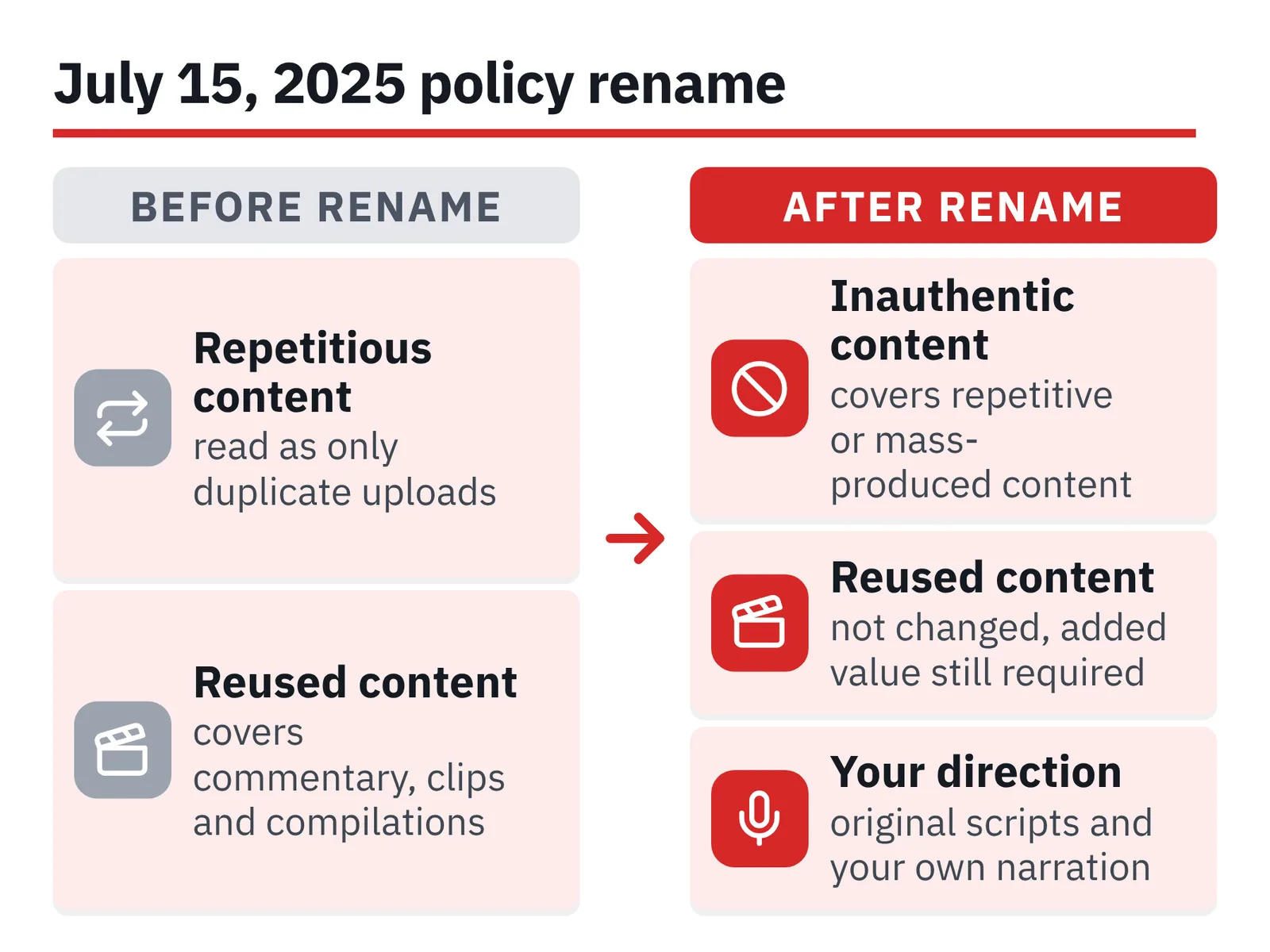
On July 15, 2025, YouTube renamed its "repetitious content" monetization policy to "inauthentic content" and clarified that it covers content that is repetitive or mass-produced, according to YouTube Help. The rename matters because creators had read the old wording as being only about duplicate uploads.
YouTube Help defines generic or repetitive content as content that looks template-made or feels repetitive after several videos from the same channel — that is the test a faceless channel has to pass. Swapping the topic in a fixed prompt and publishing the output five times a day fails it. Writing original scripts, recording your own narration and building visuals that match the argument passes it.
YouTube says its reused content policy, which reviews commentary, clips, compilations and reaction videos, was not changed by the July 2025 inauthentic content update, according to YouTube Help. If your faceless format is built on other people’s footage, that older policy is still the one you are judged against, and your commentary has to carry real added value.
AI tools sit on the safe side of the line when they speed up work you directed. They sit on the risky side when they replace the direction entirely.
Can a faceless YouTube channel be monetized? The YPP rules that apply
Yes. Nothing in the YouTube Partner Program requires a creator to appear on camera, and the thresholds are identical to any other channel’s.
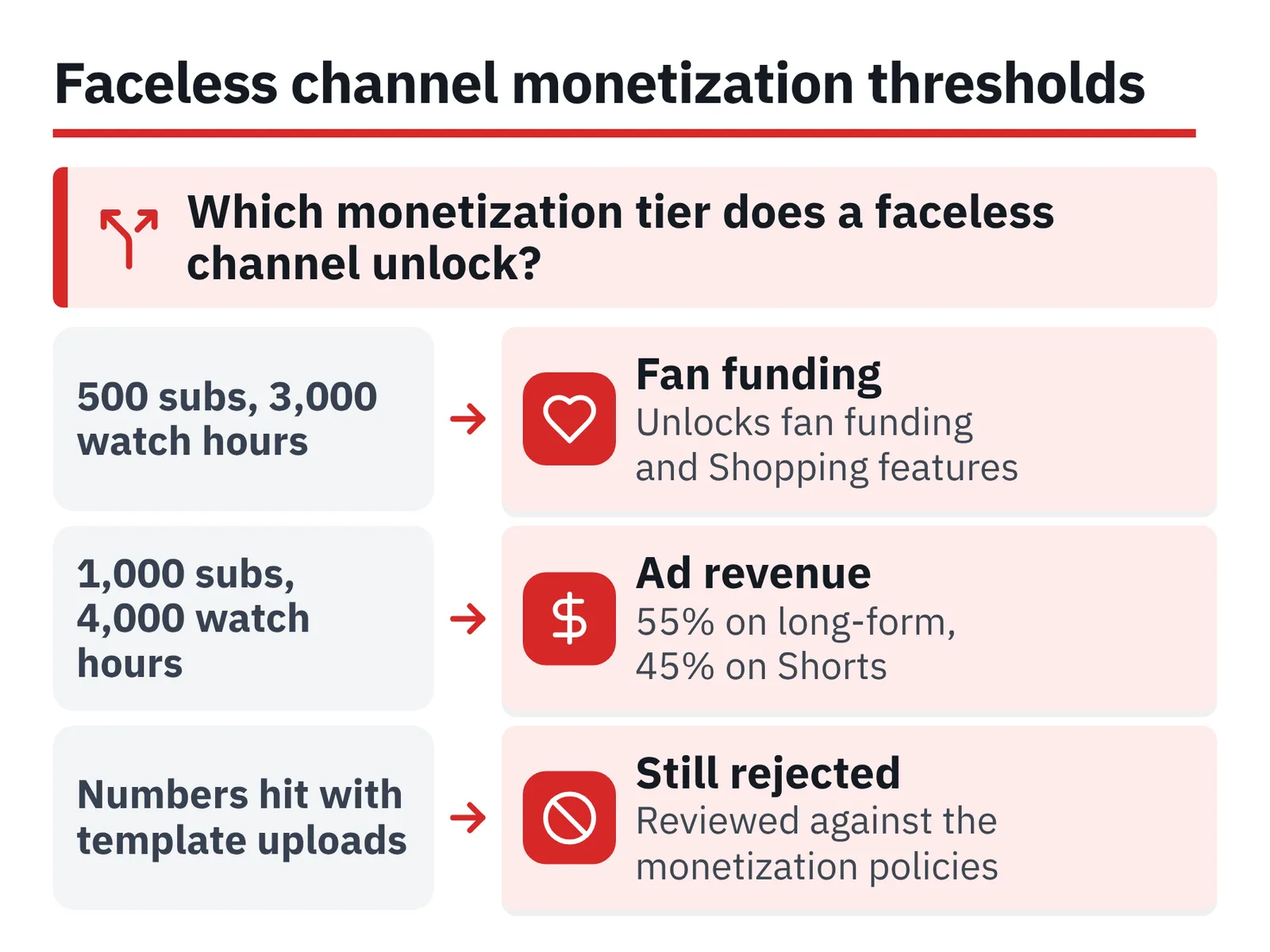
- According to YouTube Help, creators in eligible countries can join the expanded YouTube Partner Program at 500 subscribers with 3 valid public uploads in the last 90 days plus 3,000 qualified watch hours in the last 12 months, which unlocks fan funding and Shopping features.
- YouTube Help states that ad revenue sharing and YouTube Premium revenue require 1,000 subscribers plus either 4,000 qualified watch hours in the last 12 months or 10 million qualified public Shorts views in the last 90 days.
- Once a channel qualifies for ad revenue sharing, YouTube pays creators 55% of ad revenue on long-form videos and 45% on Shorts, according to the YouTube Blog.
The practical read: a faceless channel reaches the fan-funding tier on roughly the same timeline as a face-on channel, and the ad tier depends on watch hours you have to earn with retention. Working backwards from 1,000 subscribers is a useful planning exercise, and the 90-day subscriber plan built around a publishing cadence lays out one version of it.
There is also a review step people forget. Applications are reviewed against the monetization policies, so a channel that hits the numbers with template-made uploads can still be rejected.
Faceless niches and formats that work (and the audiences they serve)
Formats survive when the viewer wants the information more than the presenter. That is why these keep working:
- Software and workflow tutorials — screen recording plus narration, for people searching a specific task at the moment they are stuck.
- Hands-only cooking and baking — overhead camera, no talking, for viewers who want the method and the timing.
- Explainer and breakdown channels — charts, maps and motion text, for commuters and lunch-break viewers.
- Product research and comparisons — on-table footage of the items, for buyers deciding between two models.
- Ambient and study audio — long-form loops, for people who keep a tab open for hours.
- Kids’ learning content — animation and songs, where the rules are stricter and the review is harsher.
Match the format to where attention happens. Tutorial demand is search-driven, so titles and chapters do the heavy lifting; ambient and listicle demand is browse-driven, so thumbnails and packaging do. For a longer menu of angles with the competition levels attached, see the roundup of faceless channel ideas that still hold up.
Pick one and commit for thirty videos. Channels that rotate niches monthly train the recommendation system to show their work to nobody in particular.
Starting a faceless channel without risking demonetization
Build for the standard you will be judged against later, not the one you can get away with today.
From February 1, 2027, YouTube Help says new YouTube Partner Program applicants will need 8,000 qualified watch hours in the last 365 days or 20M qualified Shorts views instead of the current thresholds. YouTube Help also states that from February 1, 2027, a YouTube Partner Program channel counts as active if it has 1,000 qualified watch hours in the past 365 days — so staying in the program rewards a steady publishing rhythm, not a single viral month.
Five habits keep a faceless channel on the safe side:
- Write every script yourself or edit a draft heavily before recording.
- Add at least one thing no other video on the topic has — a test, a spreadsheet, a timeline, a primary document.
- Vary structure across uploads so the channel does not feel templated after four videos.
- Keep third-party footage short, credited where required, and surrounded by your own commentary.
- Review your last ten uploads as a set and ask whether a stranger could tell them apart.
Shorts deserve a decision rather than a default. They count toward separate thresholds and need their own upload habit — the phone and desktop upload walkthrough for Shorts covers the mechanics. Choose one lane, publish on a schedule you can hold for three months, and let the numbers decide the rest.
Frequently asked questions
Does YouTube allow faceless channels?
Yes. YouTube has no rule requiring a creator to appear on camera, and faceless channels are judged against the same monetization policies as everyone else. What gets channels rejected is content YouTube Help describes as template-made or repetitive after several videos, not the absence of a face.
How many subscribers does a faceless channel need to make money?
The same as any channel. According to YouTube Help, the expanded YouTube Partner Program opens at 500 subscribers with 3 valid public uploads in the last 90 days plus 3,000 qualified watch hours in the last 12 months, while ad revenue sharing requires 1,000 subscribers plus 4,000 qualified watch hours in the last 12 months or 10 million qualified public Shorts views in the last 90 days.
Is a faceless channel the same as an AI channel?
No. Faceless describes who is on screen; AI describes how the video was produced. A hand-scripted, self-narrated screen tutorial is faceless with no AI involved, while an AI-assisted video can still fail YouTube’s inauthentic content policy, which YouTube Help renamed from "repetitious content" on July 15, 2025.
How much does YouTube pay faceless creators?
Payment rates do not change with format. Once a channel qualifies for ad revenue sharing, YouTube pays creators 55% of ad revenue on long-form videos and 45% on Shorts, according to the YouTube Blog. Actual earnings depend on watch time, audience country and advertiser demand in your niche.
Will the rules for faceless channels get harder?
The entry bar rises for new applicants. YouTube Help says that from February 1, 2027, new YouTube Partner Program applicants will need 8,000 qualified watch hours in the last 365 days or 20M qualified Shorts views, and a channel counts as active with 1,000 qualified watch hours in the past 365 days.
Sources
This article was drafted with AI assistance and published by the YouTube Creators Editorial Team after its facts were checked against the sources listed above.